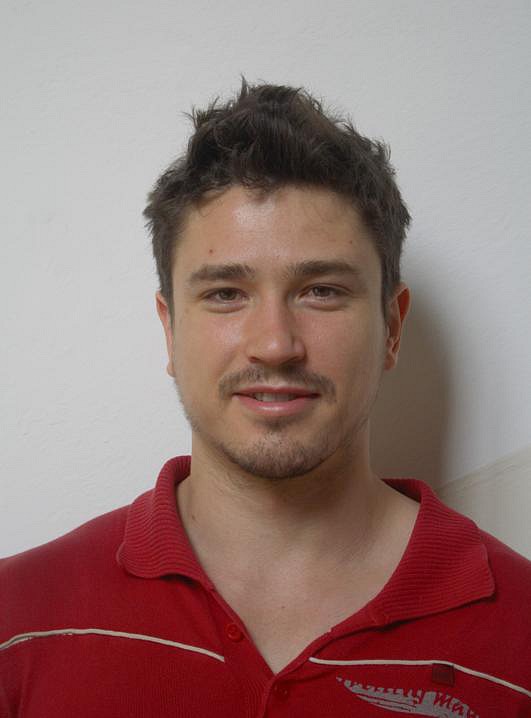
Vyacheslav Kungurtsev
APPLIED MATHEMATICS · SCIENTIFIC AI · CONTROL
From large-scale computation to real-time decisions under uncertainty.
I develop mathematical and computational methods for optimization, machine learning, and control, with an emphasis on algorithms that respect the hardware and scientific systems on which they ultimately run.
OORDSU research program Recent publications Software
Current positions
Research Scientist, Oak Ridge National Laboratory (ORNL) — Mathematics in Computation, beginning August 2026. My work centers on mathematical optimization, scientific AI, uncertainty-aware sequential decision making, and high-performance computing.
Tenured Researcher, Czech Technical University in Prague (CTU) — continuing as a secondary academic affiliation after a research career at CTU spanning postdoctoral, researcher, and tenured-researcher roles.
I received a Ph.D. in Mathematics (Computational Science) from the University of California, San Diego in 2013 and a B.S. in Mathematics, with an Economics minor, from Duke University in 2007.
Research
My work sits at the intersection of mathematical programming and numerical optimization, process and autonomous-systems control, machine learning / AI, and parallel, distributed, and high-performance computing. A recurring theme is connecting rigorous algorithms with computational and deployment realities: stochasticity, limited information, heterogeneous hardware, real-time constraints, and scientific structure.
Optimization
Nonlinear, stochastic, constrained, Riemannian, derivative-free, bilevel/multilevel, and semidefinite optimization.
Control & autonomy
Model predictive control, real-time iteration, stochastic control, mission-aligned autonomy, and sequential decisions under uncertainty.
Scientific AI
Physics- and structure-informed learning, inverse problems, dataset distillation, federated learning, and AI for scientific systems.
Computing
Algorithms spanning exascale/HPC, asynchronous and decentralized systems, and online embedded deployment.
Selected recent directions
- Offline-HPC → online-embedded decision making: OORDSU connects expensive offline modeling, policy construction, and data generation to adaptive real-time control.
- Optimization for emerging computation: variational quantum algorithms, hardware-aware optimization, and scalable parallel/distributed methods.
- Learning and control with structure: integrating domain models, geometry, uncertainty, and data rather than treating scientific systems as generic black boxes.
Links
Google Scholar · GitHub · ORCID · LinkedIn · CV (March 2026)