
OORDSU
OFFLINE-HPC → ONLINE-EMBEDDED
Real-time data-driven sequential decision making under uncertainty
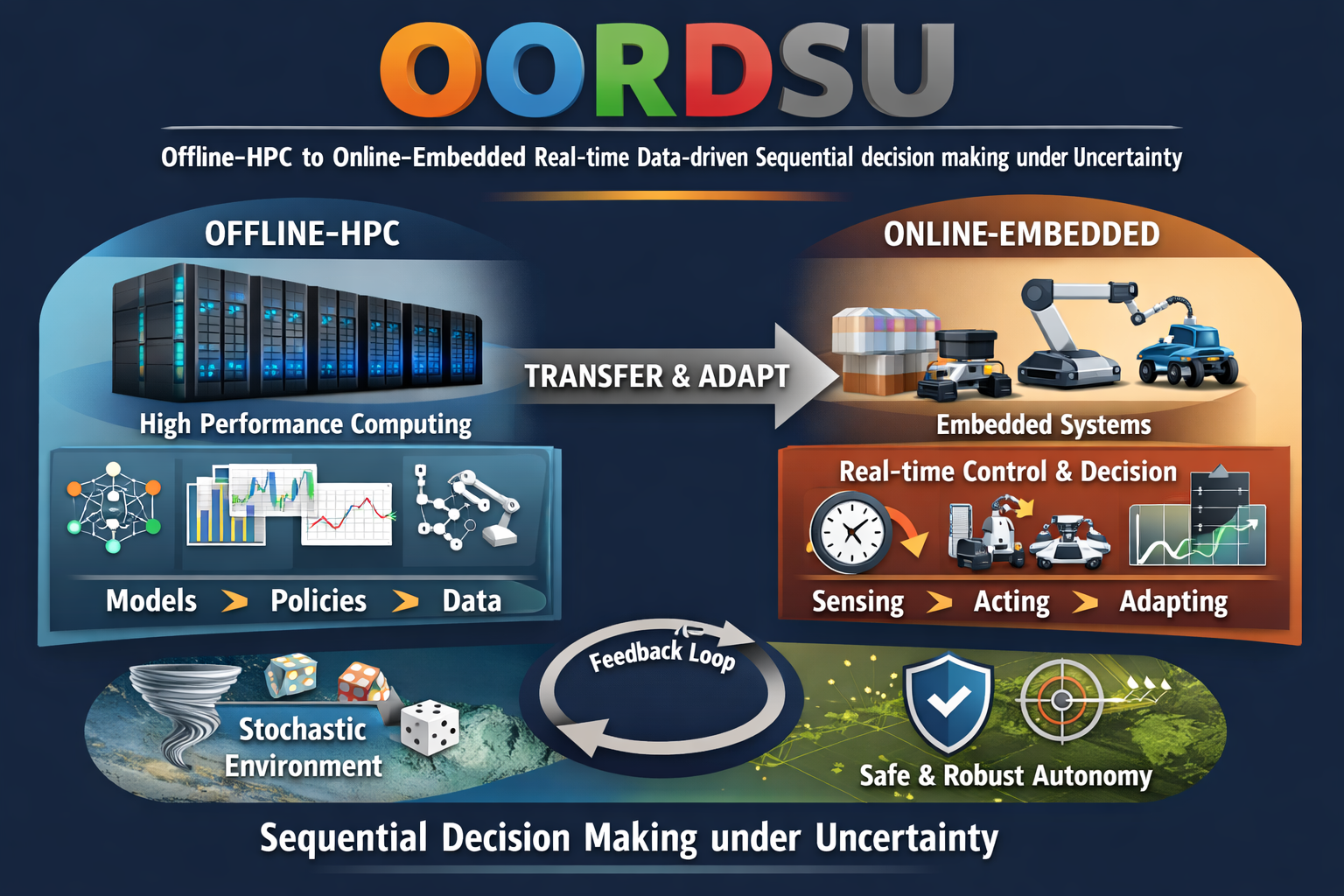
OORDSU is an organizing research program for moving from computationally intensive offline analysis to safe, adaptive online decisions on embedded systems. The problem is not merely to train a model on a supercomputer and deploy it. The central question is how models, policies, data, uncertainty representations, and safety information should be transferred, compressed, adapted, and updated as the deployed system senses and acts in a stochastic environment.
The research loop
- Offline / HPC: build models, policies, uncertainty descriptions, reference trajectories, reduced representations, and simulation-derived data.
- Transfer & adapt: identify what can be carried to embedded hardware while preserving decision-relevant information.
- Online / embedded: sense, act, and adapt under latency, memory, power, and communication constraints.
- Feedback: use deployment data, residuals, failures, rare events, and changing conditions to improve offline models and policies.
Mathematical themes
OORDSU draws on stochastic and nonlinear optimization, model predictive control, reinforcement learning, Bayesian and distributional uncertainty, rare-event risk, numerical PDEs, reduced-order modeling, and parallel/distributed computation. A particular interest is safe and robust autonomy: algorithms should know what they do not know, expose meaningful failure modes, and exploit expensive computation before deployment without assuming the world remains static afterward.
Representative work
- Mission-Aligned Learning-Informed Control of Autonomous Systems: Formulation and Foundations (2025).
- A Three-Tier Time-Scale Architecture for Controlling Complex Nonlinear Systems (2026).
- Multistage Stochastic Programming for Rare Event Risk Mitigation in Power Systems Management (2026).
- Towards Real Time Control of Water Engineering with Nonlinear Hyperbolic Partial Differential Equations (2025).
See the publications page for the broader research program.